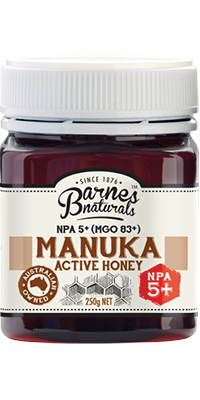
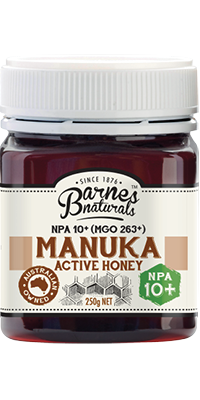
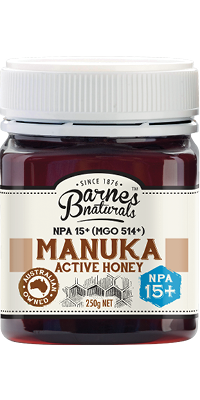
Manuka
Active Manuka honey is sourced from the flowering plant species of Leptospermum that are native to Australia and New Zealand. The indigenous people from both lands have been using Manuka in their traditional medicines for centuries.
Manuka honey contains a heightened stable form of natural antibacterial activity often known as Non-Peroxide Activity (NPA). Such intensified antimicrobial activity can be quantified using a range of testing methods. Considerable research has been undertaken to determine the cause of this activity, with it recently being attributable to the naturally occurring chemical Methylglyoxal (MGO). Manuka honey can contain more than 70 times the level of MGO found in normal honeys.
Today, following extensive clinical testing in Australia, New Zealand and other countries, the unique value of Manuka has been recognised worldwide.
Understanding Activity Levels
Active Manuka Honey is sold with varying levels of antibacterial activity, which is assigned using a rating such as Active 5+, 10+ or 15+. The scale relates to the increasing antibacterial inhibition effect of the honey on cultured bacteria (Staphylococcus aureus), in comparison to what phenol achieves. Phenol is a strong organic compound that has clear antibacterial effects, providing a stable standard for comparison purposes. Learn more.